A long day of driving, but looking forward to tomorrow. We are taking a detour off the Alaska Hwy to Skagway. It will be a taste of the inside passage cities.
We have not hooked up to electricity since we left cousin Cindy's home in Montana. Our stay in Canada and Alaska has been totally dry camping meaning park and sleep mostly in State Parks. The camp sites with electrical hookups were not always in scenic locations and were more expensive (State parks were $12 average) The only challenge has been to keep all electronics charged and and make sure the propane is full. All worked out until this morning. The propane ran out just as the coffee was done perking (thank goodness, the coffee was done). Our backup worked, kept the refrigerator cold, and we made it to the exchange place here in Whitehorse in time.
I had a camp spot picked out on the south side of Whitehorse, but we need a few other supples and Walmart was closed. When we saw the parking lot here at Walmart, we decided to stay. There must be 25 campers. There is even someone tent camping.
After Skagway, we will be at least two days in Canada. I'll write each day and post when we get back into the States.
Even though I haven't replied to your comments, I have appreciated them so much.
Sunday, August 7, 2011

Saturday, August 6, 2011
Denali Highway Friday August 6
The highway from Anchorage to Denali National Park is called the Parks Highway. It was built in 1972. Before that time, visitors to what was then called Mt. McKinley National Park traveled on the Danali Highway. It is 134 miles long. Perhaps by design, the state of Alaska has chosen not to improve this road. It is as it was when early travelers made the trip, requiring modern travelers to also move slowly. And, this road should be taken slow. It is unforgettable.
There are valley vistas as far as the eye can see. Small beaver ponds, lakes and clear streams all along the road. Information tells us there are trout in most. The valley floor is framed by mountains, green low, some snow and even a small glacier higher up.
There are informal pull outs, but they were not needed as there was so little traffic. I think we met or came up only four other small RVs and less than ten cars & trucks. We often stopped right on the road.
Here are a few pictures of the journey


We also saw a herd of caribou, eagles, swans, moose, sheep,a wolf and even little bunnies.
As the day began to ebb and the beautiful Denali Park and Road was in our rear view mirror, I spent a little time feeling really down. It was pretty quiet travel. I always do this when I know the end of our trips is in sight. Yes, we are headed south. Currently, we are back on the Alaska Highway. We will be tack in Tok tomorrow—a circle. There will be a couple side trips. Skagway and Prince Rupert but we will be continuing south. I’m feeling better as I write this (11:00 pm Friday Alaska time). We found a pull off along a bubbling stream which is always nice.
Friday, August 5, 2011
Denali National Park – More beautiful than words to describe
We are leaving soon for a cut off across the range that might mean no internet tonight. So, here are a few pictures that in no way can show how beautiful our trip was last night. We did not see Mt. McKinley, but as the literature says, “It is there.” No matter, because the park is pristine and grand. We saw a bear eating a caribou carcass that two wolves had killed. At least one was circling around the bear, the other held back. Wildlife living without human interference.
So, here are my three little pictures to tell a big story
The road:


The end:

Thursday, August 4, 2011
Denali National Park. Thursday afternoon
I was willing clear skies this morning as we approached the Park. No luck. Still, we've had spots of sunshine. Last night I lucked into a camp spot inside the park on line so no worry about a camp spot.
I also booked an evening tour into the park leaving at 5:00pm. It is a 6 hour tour so maybe a sunset.....better yet a glimpse of Mt McKinley
I'll post pictures tomorrow.
I also booked an evening tour into the park leaving at 5:00pm. It is a 6 hour tour so maybe a sunset.....better yet a glimpse of Mt McKinley
I'll post pictures tomorrow.
Portage Glacier/Whittier then on-the-road to Denali Wednesday
I have to admit, I got rather paranoid last night.
I mentioned we were at Portage Glacier. However, I don't think I mentioned how hard it was raining and blowing. I told myself there is no worry about wind damage in Alaska, but then I thought of the high mountains around me and then I thought flash flood. So, I went to bed, went to sleep and nothing happened. As Dan pointed out this morning, all water drains into the sea from where we were and it's hard to back that one up!

It was still raining just as hard this morning so we decided to move on with our day and not enjoy our coffee as usual. That is how we managed to eat at the Portage Glacier Lodge. What a surprise--another place for my "must go to in Alaska" list. It is just a little dinner, but Dan had a very delicious (I tasted it) Alaskan Skillet with eggs, green onions, boursin cheese, and smoked salmon. I had two huge pancakes. Once again we learned so much by talking to those who live here.
They told us the Portage Glacier valley including Whittier has in the past received more snow than any location in Alaska. Whittier is an old military town where supplies were brought in during WWII. There are tunnels connecting most of the buildings because it gets so much snow in the winter. It is only in the past ten years that the one-way 2 1/4 mile tunnel has been converted to allow cars to alternately go back and forth when there is no train.
The tunnel is impressive. I am glad we experienced it. There was a huge cruise ship in port at Whittier, which was the only excitement there. Definitely, a working port.

As we drove out of the valley, it was still raining heavily. By the time we arrived at Anchorage, there was a sliver of sun here and there. Our friend, Carol from the museum in Soldotna told us to to to the Alaska Native Medical Center for beautiful displays of native art and creativity. She was right. When the Alaska Natives require extended stays at the hospital, they fill their time creatively carving bone, sewing animal fur, beadwork as well as wood and silver carving. It is beautifully displayed and all for sale in the gift shop. So tempting but very expensive.
From there, we are headed to Denali.
I mentioned we were at Portage Glacier. However, I don't think I mentioned how hard it was raining and blowing. I told myself there is no worry about wind damage in Alaska, but then I thought of the high mountains around me and then I thought flash flood. So, I went to bed, went to sleep and nothing happened. As Dan pointed out this morning, all water drains into the sea from where we were and it's hard to back that one up!
It was still raining just as hard this morning so we decided to move on with our day and not enjoy our coffee as usual. That is how we managed to eat at the Portage Glacier Lodge. What a surprise--another place for my "must go to in Alaska" list. It is just a little dinner, but Dan had a very delicious (I tasted it) Alaskan Skillet with eggs, green onions, boursin cheese, and smoked salmon. I had two huge pancakes. Once again we learned so much by talking to those who live here.
They told us the Portage Glacier valley including Whittier has in the past received more snow than any location in Alaska. Whittier is an old military town where supplies were brought in during WWII. There are tunnels connecting most of the buildings because it gets so much snow in the winter. It is only in the past ten years that the one-way 2 1/4 mile tunnel has been converted to allow cars to alternately go back and forth when there is no train.
The tunnel is impressive. I am glad we experienced it. There was a huge cruise ship in port at Whittier, which was the only excitement there. Definitely, a working port.
As we drove out of the valley, it was still raining heavily. By the time we arrived at Anchorage, there was a sliver of sun here and there. Our friend, Carol from the museum in Soldotna told us to to to the Alaska Native Medical Center for beautiful displays of native art and creativity. She was right. When the Alaska Natives require extended stays at the hospital, they fill their time creatively carving bone, sewing animal fur, beadwork as well as wood and silver carving. It is beautifully displayed and all for sale in the gift shop. So tempting but very expensive.
From there, we are headed to Denali.
Wednesday, August 3, 2011
Alaskans love their coffee
Maybe it's the long, dark winters or probably more likely the long light summers, but Alaskans love their coffee. In the larger towns, and even more in small towns, there are coffee kiosks, sometimes one each block. Generally, they are small, very small, buildings sitting in a parking lot or just along the street.


I started taking pictures, but Dan certainly was not going to stop at each. So, we wrote down a few names: Sugar Shack, Top Dog Expresso, Bikini Girls Expresso (he was ready to stop at that one), The Hot Spot, Jungle Juice, Let Freedom Ring, Hooked on the Bean and Java Junction. And, of course, the Lovn' Oven Bakery and Expresso where we purchased our breakfast.
I bought some freshly ground coffee at a farmer's market in Anchorage. We enjoyed strong, dark Alaskan coffee all the way home.
Here are two that were so unique that Dan actually turned around so I could get a picture.


The popular place in Soldotna

Steward Alaska SeaLife Center, Exit Glacier and Portage Glacier Tues. August 2
Our plan was to ride our bikes to the SeaLife Center. We knew we could because we rode there last night. Only we woke this morning to rain—real rain, not the drizzle we’ve had in the past.
The Alaska SeaLife Center is a learning center about all aspects of Alaska waters and wildlife that lives and feeds in, on and around it. Included are displays about their habitat, life cycles, health and history and plans for the future for sea life. Birds and sea creatures are visible from the top as well as under the water.


.
We attended an informative session about Alaska’s early inhabitants by an Alaska Wildlife and Parks ranger. Recent archeological findings have placed early Alutiiq people on the Kenai peninsula living by hunting fur bearing animals 1,400 years ago. In 1741 Russian fur traders forced the native people to hunt for them by removing the strongest men from villages. Within 25 to 30 years after the Russians arrived, 30% died of starvation and soon after another 30% died of small pox. The native people have persevered and there are settlements throughout the Kenai, one of them the Nimlichik village were we dug for clams.
If the weather would have been clear, we might have been able to spot some of the sea creatures in the ocean from a stand complete with a viewing scope. Unfortunately, it was too cloudy. Still, an very well done and educational venue.
As we leave Seward, we drive a short distance into Exit Glacier National Park. There was excitement in doing that with a short drive through fairly swift water over the road. Actually, the road was starting to wash out. I was thankful for our big truck with weight.
The climb to Exit Glacier was wet, but we were able to see the massive ice field up close. This sign says it all. Even with the rain, we could feel the life in the massive glacier.

The mile walk to the glacier.

Up close.

On the way back, we walked down in the valley below the glacier. The run off was too swift otherwise we would have been able to walk to the bottom.
We've seen many glaciers in Alaska and the Columbian Ice Fields in Banff Park, but up close leaves me without words to describe or compare.
Tuesday, August 2, 2011
Sea Otter in Seward Alaska Harbor
Check out this video on YouTube:
http://www.youtube.com/watch?v=sI1Mq-4MevI&feature=youtube_gdata_player
Monday, August 1, 2011
Ninilchik Beach to Seward Beach August 1
We decided to try out the bakery down the way from our campsite this morning.

It turns out the "Loven' Oven" bakery is owned by the former postmaster of Ninilchik. We had to talk post office for a bit while she wrapped up a huge cinnamon roll and doughnut.
Our route to Seward takes up back through Soldotna then on by the Russian River. The silver salmon had arrived. "Combat" fishermen lined the shore. Often bears join fishermen in catching salmon here. We looked but, unfortunately, that picture did not happen.
We continue up, around and down the other side of the peninsula. It is a scenic drive with streams and low, green mountains. It mist-like rained all day and the low clouds topped most mountains with a beauty all of its own.
Seward is a quaint, little, sea side village. Or, at least it seems that way. No McDonalds or WalMart, just small little shops and restaurants. We spent the rest of the afternoon riding our bikes.
 Benny Benson is the young man who designed the Alaska state flag. There was a contest among the Alaska school children. Benny won with his stars in the form of the big dipper and north star. As an adult, he had a colorful personality and was well known among the native citizens.
We decided on a camp spot that is right beside the bike trail so we can hop on it and visit the Marine center tomorrow morning. The ocean is right out our other side. I am listening to the tide come in as I write.
 (Truck is looking like it needs a wash job in this picture!)
There is a sea otter that lives in the small boat cove here. I made a video of him. YouTube hasn't finalized it yet. I'll post it in the morning. Meanwhile, here is a picture of a huge waterfall almost right in town.


It turns out the "Loven' Oven" bakery is owned by the former postmaster of Ninilchik. We had to talk post office for a bit while she wrapped up a huge cinnamon roll and doughnut.
Our route to Seward takes up back through Soldotna then on by the Russian River. The silver salmon had arrived. "Combat" fishermen lined the shore. Often bears join fishermen in catching salmon here. We looked but, unfortunately, that picture did not happen.
We continue up, around and down the other side of the peninsula. It is a scenic drive with streams and low, green mountains. It mist-like rained all day and the low clouds topped most mountains with a beauty all of its own.
Seward is a quaint, little, sea side village. Or, at least it seems that way. No McDonalds or WalMart, just small little shops and restaurants. We spent the rest of the afternoon riding our bikes.

We decided on a camp spot that is right beside the bike trail so we can hop on it and visit the Marine center tomorrow morning. The ocean is right out our other side. I am listening to the tide come in as I write.

There is a sea otter that lives in the small boat cove here. I made a video of him. YouTube hasn't finalized it yet. I'll post it in the morning. Meanwhile, here is a picture of a huge waterfall almost right in town.

Sunday, July 31, 2011
Clams? Yes, but it is work
Low tide was scheduled for 10:30 am. We were on the beach on 9:30—along with many others
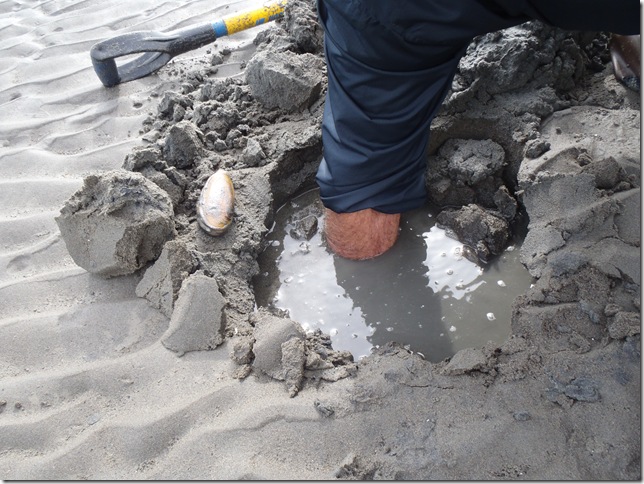
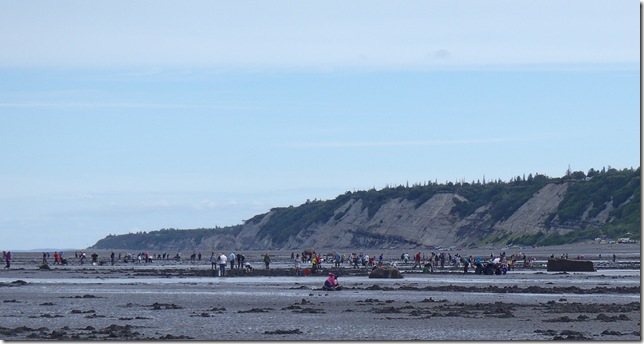 It is a big beach and there was plenty of room for everyone. We managed to get about 30 clams. It took a while to develop a technique. First, we looked for a little indention in the sand—a little air hole. We shoveled out sand, hopefully not hitting the clam and breaking it open. (broken clams are very hard to remove all the sand). After digging a shovel full, we dropped down on our knees and started digging with our hands. This picture shows how deep Dan went down to get the clam by the hole.
We quit at 11:00.
 I had Dan’s rain pants with sock feet boots. Dan wore waders. We were a mess top to bottom. Thankfully, the sun was out all afternoon and dried everything out.

Finished batch.
Thanks to friends of Chips at the Soldotna campground and a very helpful camp host here at Niniletuk, we had a whole lot of fun. Speaking of Chip, he and a friend showed up this morning. They definitely found more than we did, but, hey, they had done it before.
Tomorrow, we are headed toward Seward.
 It is a big beach and there was plenty of room for everyone. We managed to get about 30 clams. It took a while to develop a technique. First, we looked for a little indention in the sand—a little air hole. We shoveled out sand, hopefully not hitting the clam and breaking it open. (broken clams are very hard to remove all the sand). After digging a shovel full, we dropped down on our knees and started digging with our hands. This picture shows how deep Dan went down to get the clam by the hole.

We quit at 11:00.
 I had Dan’s rain pants with sock feet boots. Dan wore waders. We were a mess top to bottom. Thankfully, the sun was out all afternoon and dried everything out.

Finished batch.
Thanks to friends of Chips at the Soldotna campground and a very helpful camp host here at Niniletuk, we had a whole lot of fun. Speaking of Chip, he and a friend showed up this morning. They definitely found more than we did, but, hey, they had done it before.
Tomorrow, we are headed toward Seward.
Saturday, July 30, 2011
Ninilchik Beach State Campground
We will be digging for clams on Ninilchik Beach tomorrow morning. Rather than drive the 30 miles down to the beach from Soldotna, we are staying right here on the beach. This picture out our camper door shows the historic town of Ninilchik, a Russian settlement along the Cook Inlet coastline. The old settlement is down in the valley. The historic church is on the hill directly across from our campground. There is a stairway down to the beach which is to the left of the picture.

I’ve decided clamming is a family and friends time for local residents. There are large groups of families camped together with children running about having a great time.
This little one gets to participate in all the action thanks to big brother.


I’ve decided clamming is a family and friends time for local residents. There are large groups of families camped together with children running about having a great time.
This little one gets to participate in all the action thanks to big brother.

Friday, July 29, 2011
Catch Up day and a decision
Part of the reason this day became a sort of catch up day is we couldn't make a decision. Here's our problem.
We were going to take off for destinations north, but thought maybe we would fish for salmon a while longer since we have three days left on our licenses. Then, we decided we should join half the state of Alaska on Sunday morning digging for clams. It is the low tide necessary then.
We've never dug for clams before. We're finding out there are many ways to do it as there are people digging. We didn't want to buy a clam shovel because we have no need in Kansas. We bought a spade. I think we'll move closer to the beach we want to dig on tomorrow. Of course I'll take a few pictures.
Homer back to Soldotna Thursday, July 28
Anchor Point was one of my favorite campgrounds so far. It is an Alaska Wildlife and Parks maintained area. Except for the city campground in Soldotna, we have stayed in State or National campgrounds. We find them clean, well regulated and affordable.
Another interesting feature of Anchor Point was their ocean boat ramp. They had huge tractors that had huge tires and would drive way out into the ocean with boat trailers to pick up boats. I didn’t take a picture but worth a stop at the campground just to see it happen.
From Anchor Point, we took a scenic route back to Homer. Here we discovered another Russian settlement. This is a picture of their small Russian Orthodox church.


Again at Homer, we visited the Alaska Islands & Ocean Visitor Center. First, we viewed two movies, one about the Tiglax, a ship owned by the US Fish and Wildlife Service. There are many species of birds and other wildlife the Aleutian Islands that is constantly monitored. Major predators of different species of birds and animals have both been introduced, fox and rats.
Fox as part of an effort in the late 1800s to ”fox farm.” There was a great demand for fur at that time so pairs of fox were introduced on many of the islands. These predators soon caused a major upset in the food chain. Rats were introduced with ship wreaks.
Thanks to constant monitoring, mainly through the use of the Tiglax and removal of many of the fox, the balance is being restored on the remote islands.
Afterward, we followed the advice of the docent at the museum and stopped by 2 Sisters Bakery. The loaf of bread is delicious, as was the cookie Dan and I shared.
This evening we met a very kind and friendly lady named Elizabeth. She found my phone on the beach and called to let me know she would meet us to give it back. She would accept no payment for her time and gas. Once again we have found the local residents to be helpful, friendly and just good people.
Thursday, July 28, 2011
Homer Wednesday, July 27
If I described our campsite on the spit last night, you would probably think it was a nice setting. It might have been, but it rained all evening and we had to stay inside. It was still drizzling this morning so we left to drive around the lower point of the peninsula. Definitely wet sand it not a friend of this small space.
Before I leave the topic of the spit, though, here is a picture I took this afternoon as we left town for our campground that shows how this narrow piece of land called a “spit” goes out into the inlet.

What a beautiful drive around the point of the Kenai peninsula. We took several side roads. It was on one of the remote backroads that we came across this cemetery. We thought it might have been Russian because of names we saw in the area. Perhaps because of the sea salt, the crosses were all aluminum.

We noticed as we came through town earlier there was to be a farmer’s market from 3:00 until 6:00 pm. Since it was already 1:30, we decide to use the parking lot to eat lunch and wait until it opens. I fixed salmon for lunch—delicious.
.
I purchased a huge cabbage as well as rhubarb. I really don’t have room to store extra food, but it just looked so good. They use hot houses and a “tunnel” which is a covering over the entire garden to make their growing season last longer. Here is an example.

The cabbages!

We decided earlier to camp at the Alaska State Park site at Anchor Point. So here we are. We had time to ride our bicycles on the beach before cooking half the cabbage.

The highlight of the day was the end. We haven’t had many opportunities for sunsets here in Alaska. So often a rain comes up at the end of the day. Tonight, however, there was a brilliant sunset. Even though it wasn’t of the actual sunset, I like this one the best. You know how the sun sets, of course. It slips down and then drops below the horizon. The sun here doesn’t exactly drop, it slides sideways down. It should be noted here that it was 11:15pm when it finally fully disappeared. It was twilight a while after that. This sunset was the longest one I’ve ever witnessed. Definitely a thrill and memory I’ll cherish.

Wednesday, July 27, 2011
Soldotna to Homer Tuesday, July 26
The Centennial campground at Soldotna has an unusual system. Payment is by the day or week which is noted on a slip of paper. Then, you can move that slip of paper around as campsites open. That is how we were a part of Chip’s”hood” last night, at least his friends call it that. It was just a short walk down to the river where Dan caught two more salmon last night.
Before leaving Soldotna, we visited the Homestead Museum. Definitely it should be put on a “must see” list for any visit to the Kenai area. I say this because it is a well done example of the recent history of the state with furnished log cabins and early fishing boats. Our docent, Caroll, grew up in Soldotna, her parents settled there when land opened up, with preference for veterans, after World War II. Caroll is my age. She personally saw the peninsula grow from the very beginning. She was in the earthquake in the spring of 1964 and told of how it broke up the thick ice on the lake nearby nearly killing her brother.
I barely got away from there, though....

From Soldotna, we drove on down the peninsula toward Homer on the Seward Highway. Clam Gulch seemed a good place for lunch. The sign said, no cars on the beach unless 4-wheel drive. We’re that, so down we went right out on to the beach—and right down into the soft sand. After we backed out, with our 4-wheel drive, we decided maybe they didn’t mean with a heavy camper. We still had a beautiful view from the spot by the road while we ate our lunch. I looked for pretty rocks while Dan spied on an eagle and what might have her young one.

We are now sitting on the Homer Spit, parked on the beach looking out over the ocean. I am hoping the weather clears so I can get a picture of how beautiful this spot really is.
Tuesday, July 26, 2011
One more salmon post

Chip foul hooked (hooked anywhere but the mouth) this evening. Salmon have to be hooked in the mouth so we couldn’t keep it.
Chip is our friend and neighbor and also Dr. Chip, a professor at KU. After dinner tonight he explained the salmon migration. Fry are baby salmon. They are born in their own part of a river meaning because they are born there, it is their home. When they reach about 1 1/2 years old, they swim to the ocean. At that time they are called Smolts.
At age four or five, they return to the place they were born to spawn and die. So that is why the fish are moving up the Kenai River where we are camped. The Kenai flows into the ocean so it is their entry way to other rivers and creeks upstream.
We are fishing for Red Salmon or sockeye. Chip says all salmon have two names. King Salman or chinook, Silver Salmon or coho, Chum Salmon or dog and Rink Salmon or humpback.
As the salmon swim up the river, smell tells them where to hatch. They may cross by several rivers or streams before one smells right to them. Chip told us not to miss the salmon hatchery in Valdez that releases salmon each year. When these released salmon return to spawn, they return to the hatchery where they are two and three deep trying to get back in. Of course, there is no entry.
Salmon swim two miles an hour and may swim as may as 70 to 90 miles. The longest commute is 3,000 miles on the Yukon River.
We are moving on to Homer today.
Sunday, July 24, 2011

Saturday Farmers Market Day
I mentioned yesterday we were planning on getting up at 3:30 in order to be fishing by 4:00 am. Believe it or not, we were on the river at 4:15 am. It was twilight at that time. As I said before, the sun coming up over the river is beautiful. We caught three salmon as well
.
When we were in Kenai watching the dip netting yesterday, we noticed there was a farmers market scheduled for the Kenai Welcome Center parking lot. We were interested to see what fresh vegetables would be available. As it turns out, not many. There were some nice cabbages, though. Even though the growing season is short, plenty of rain and long days is enough for cool weather vegetables.
The most impressive booth was the beautiful pieces of clothing made from locally trapped fur. There were boots, hats, and scarves. I did not take any pictures, but here is the web site for Howling Wolf Furs which tells the artist’s story and here is her order web site there are pictures of her creations.
.
In the end, all we purchased was a garlic scape pesto. The vender explained that scape is the top of the garlic that is cut before it gets mature. It is delicious
.
After reindeer brat for lunch, we did some wash. Then late this afternoon, the fishing picked up again and Dan caught three more fish.
I'm getting spoiled with Chip's cooking. Tonight we had salmon rice pilaf. He is exceptional with the seasoning bottles.
We are staying here at the Centennial campsite until Monday morning so I can replace my phone.
.
When we were in Kenai watching the dip netting yesterday, we noticed there was a farmers market scheduled for the Kenai Welcome Center parking lot. We were interested to see what fresh vegetables would be available. As it turns out, not many. There were some nice cabbages, though. Even though the growing season is short, plenty of rain and long days is enough for cool weather vegetables.
The most impressive booth was the beautiful pieces of clothing made from locally trapped fur. There were boots, hats, and scarves. I did not take any pictures, but here is the web site for Howling Wolf Furs which tells the artist’s story and here is her order web site there are pictures of her creations.
.
In the end, all we purchased was a garlic scape pesto. The vender explained that scape is the top of the garlic that is cut before it gets mature. It is delicious
.
After reindeer brat for lunch, we did some wash. Then late this afternoon, the fishing picked up again and Dan caught three more fish.
I'm getting spoiled with Chip's cooking. Tonight we had salmon rice pilaf. He is exceptional with the seasoning bottles.
We are staying here at the Centennial campsite until Monday morning so I can replace my phone.
Friday, July 22, 2011
Dip netting on the estuary
An estuary is a place where salt water meets fresh water. At high tide the salt water may be 12 miles up river. However, it was low tide when we traveled to the city of Kenai to watch for ourselves the dip netting that only Alaska residents can participate.
The dip nets are huge. They are hooked to the top of small cars traveling to the beach to participate in this Alaska tradition.
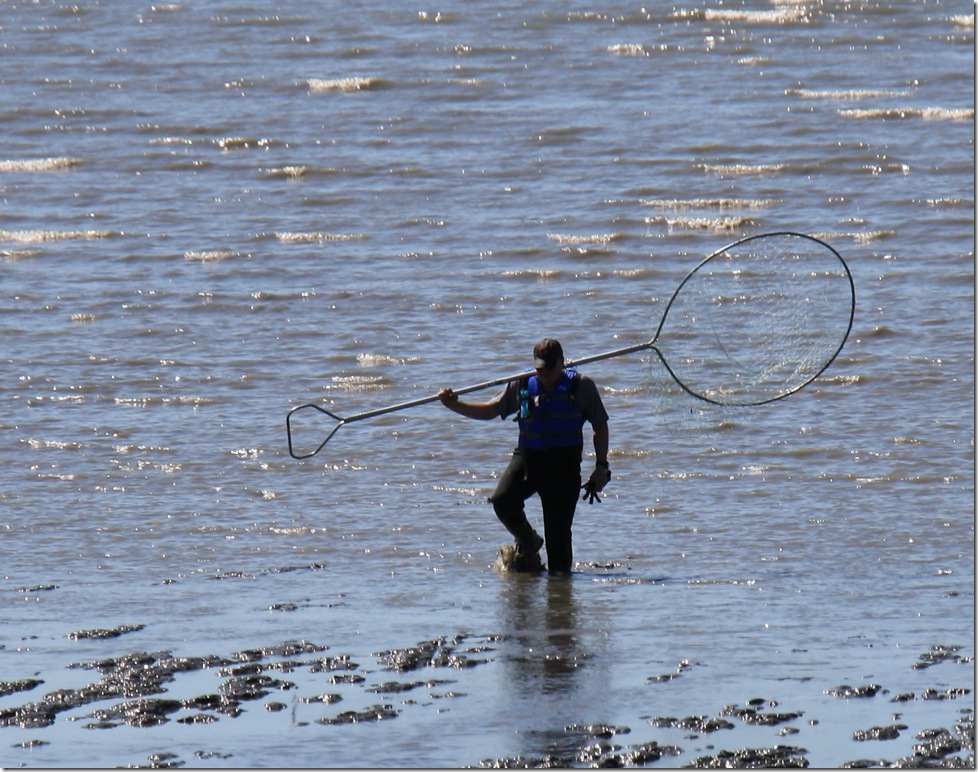
The netters form lines along the inlet and as the tide comes in with their big nets. Sometimes they will form a “conga” line where they all work together to get the fish.
There are tents, RVs, food vendors out on the beach. It looked like everyone was having a great time. And, the weekend crowds weren’t even there yet.
 Notice the mud the guy with the net is walking through. It is almost like quick sand. We visited with a friendly local man about his day of netting and he said years back, there were people killed when they became stuck in the mud and the tide came in. While we were visiting, he explained that a old looking plane struggling to gain altitude out over the inlet was full of gasoline for the remote settlements. How about flying an old airplane full of gas for a job!
It was a beautiful sunny day today. Still only in the 70s. Not to say that to rub in our cool temperatures to our family and friends in sweltering Kansas, but to say once again how beautiful weather we have been fortunate enough to have here. Everyone says it is more often than not, rainy. The other interesting thing is when the weather is sunny, the parents let the children play until there is no longer light—11:00 or later. I guess they experience enough darkness in the winter
.
While I’m on the subject of interesting observations, there are handguns for sale in the grocery store and fishing supplies in the hardware store here in Soldona. Only in Alaska.
The only down part of the day is that I lost my cell phone, possibly on the beach. We retraced all steps but could not find it. So, I disconnected service to my number until Monday when I can get a new phone.
Got to get to bed. Plan on getting up to fish at 4:00 am. A final picture of Mt Redoubt, an active volcano, visible from the beach.

The dip nets are huge. They are hooked to the top of small cars traveling to the beach to participate in this Alaska tradition.

The netters form lines along the inlet and as the tide comes in with their big nets. Sometimes they will form a “conga” line where they all work together to get the fish.
There are tents, RVs, food vendors out on the beach. It looked like everyone was having a great time. And, the weekend crowds weren’t even there yet.
 Notice the mud the guy with the net is walking through. It is almost like quick sand. We visited with a friendly local man about his day of netting and he said years back, there were people killed when they became stuck in the mud and the tide came in. While we were visiting, he explained that a old looking plane struggling to gain altitude out over the inlet was full of gasoline for the remote settlements. How about flying an old airplane full of gas for a job!
It was a beautiful sunny day today. Still only in the 70s. Not to say that to rub in our cool temperatures to our family and friends in sweltering Kansas, but to say once again how beautiful weather we have been fortunate enough to have here. Everyone says it is more often than not, rainy. The other interesting thing is when the weather is sunny, the parents let the children play until there is no longer light—11:00 or later. I guess they experience enough darkness in the winter
.
While I’m on the subject of interesting observations, there are handguns for sale in the grocery store and fishing supplies in the hardware store here in Soldona. Only in Alaska.
The only down part of the day is that I lost my cell phone, possibly on the beach. We retraced all steps but could not find it. So, I disconnected service to my number until Monday when I can get a new phone.
Got to get to bed. Plan on getting up to fish at 4:00 am. A final picture of Mt Redoubt, an active volcano, visible from the beach.

Catching up on Salmon July 21
Somehow I lost a day on this journal. Time to fill it inThe Kenai River flows past the Centennial campground where we are staying. It is a wide fast flowing river, maybe like the Kaw when it’s high. Many of the streams formed by melting snow empty into it, so it’s cold. Salmon come in from the ocean to begin their journey to spawn at their birthplace river here. According to the Anchorage Daily News, There are record numbers running through the fish counter at the river’s mouth—230,600 salmon in one day. Some year's peak doesn't hit 100,000
.
This picture was taken at 5:00 am this morning. After not having a lot of luck yesterday, we decided to get out there early.
Obviously we were the only ones with this idea. Here it is looking the other direction.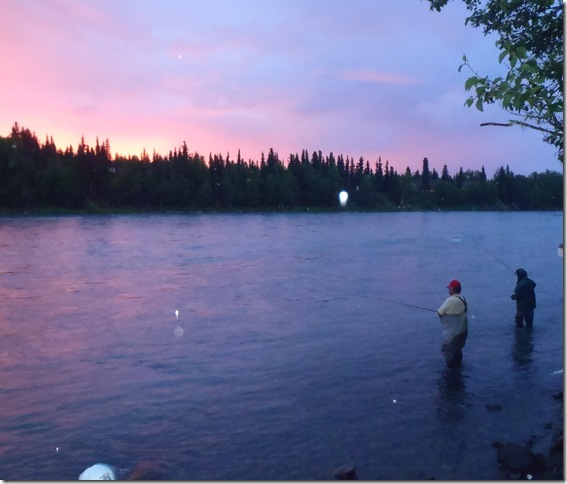


I later found out some were out at 2:30 am! First, fly fishermen are serious about their sport. The lady in the foreground moved so we could get in. Oh, yes, and it was raining. By 8:30 am, I had lost two fish and my feet were froze. Dan took a break a little earlier so he came down with hot coffee. That helped.
We finally quit around 11:00. Chip, Dan and I were rotating in one spot. When we quit, we lost the spot. That’s OK because I was tired. This afternoon, we cleaned up all the salmon fillets and vacuum packed them. Chip took them to a place that will freeze, store and mail them at the right time.
What is interesting, though, is the personality of this campground. Through Chip, we have met many of the other visitors and learned their routine. Many bring pressure cookers to can their salmon. This evening we visited with a gentleman who had been tending his smoker full of salmon all day. Everyone is having a good time all centered around the salmon harvest.
Here’s how I understand how salmon are caught. After they enter the rivers from the ocean, they have trouble with the change in water so are swimming with their mouths gapping open. Catching them involves throwing a line out and letting the current carry it down and hoping one of the salmon will be swimming by with their mouth open and grabbing the hook. If any of them are caught in any other part of the body than the mouth, they have to be thrown back. It’s not as easy as it sounds. There is technique, but in the end, there is also luck.
Subscribe to:
Posts (Atom)